How to Choose a Chimney Liner Installer
Last updated: November 16, 2026
Quick answer: choose a chimney liner installer who inspects first, explains the liner choice in plain language, and backs the job with insurance, written terms, and a real warranty. For how to choose a chimney liner installer, the safest starting point is one thorough chimney inspection before you sign. The person you hire should connect the chimney inspection, the stove or appliance, and the liner work to current safety standards such as NFPA 211.
How do I judge a chimney liner installer?
A good chimney liner installer is the one who treats the chimney as a system, not a tube to sell. That means the person asks about the appliance, the flue, the fuel type, and the condition of the chimney before talking about parts or labor.
Start with the first call. If the installer asks only for chimney height or a photo, that is thin screening. If the installer asks whether the appliance is a stove, fireplace insert, or furnace connection, and whether there has been a recent chimney inspection, that is a better sign.
A useful rule is simple: the installer should sound like a chimney professional, not a parts seller. A chimney sweep may do the inspection and cleaning. A stove technician may know the appliance side. The better choice for liner work is usually the person who can explain how those pieces fit together, especially where clearances, draft, and condensation can affect the job.
| Type of professional | What they usually handle | Where they fit best | Weak spot to watch |
|---|---|---|---|
| Chimney sweep | Inspection, sweeping, basic chimney condition checks | First stop before liner work | May not handle every appliance detail |
| Installer | Liner sizing, fitting, connection, termination | Direct liner projects | Quality varies a lot by documentation |
| Stove technician | Appliance hookup, venting needs, stove clearances | Stove and insert jobs | May not inspect the whole chimney structure |
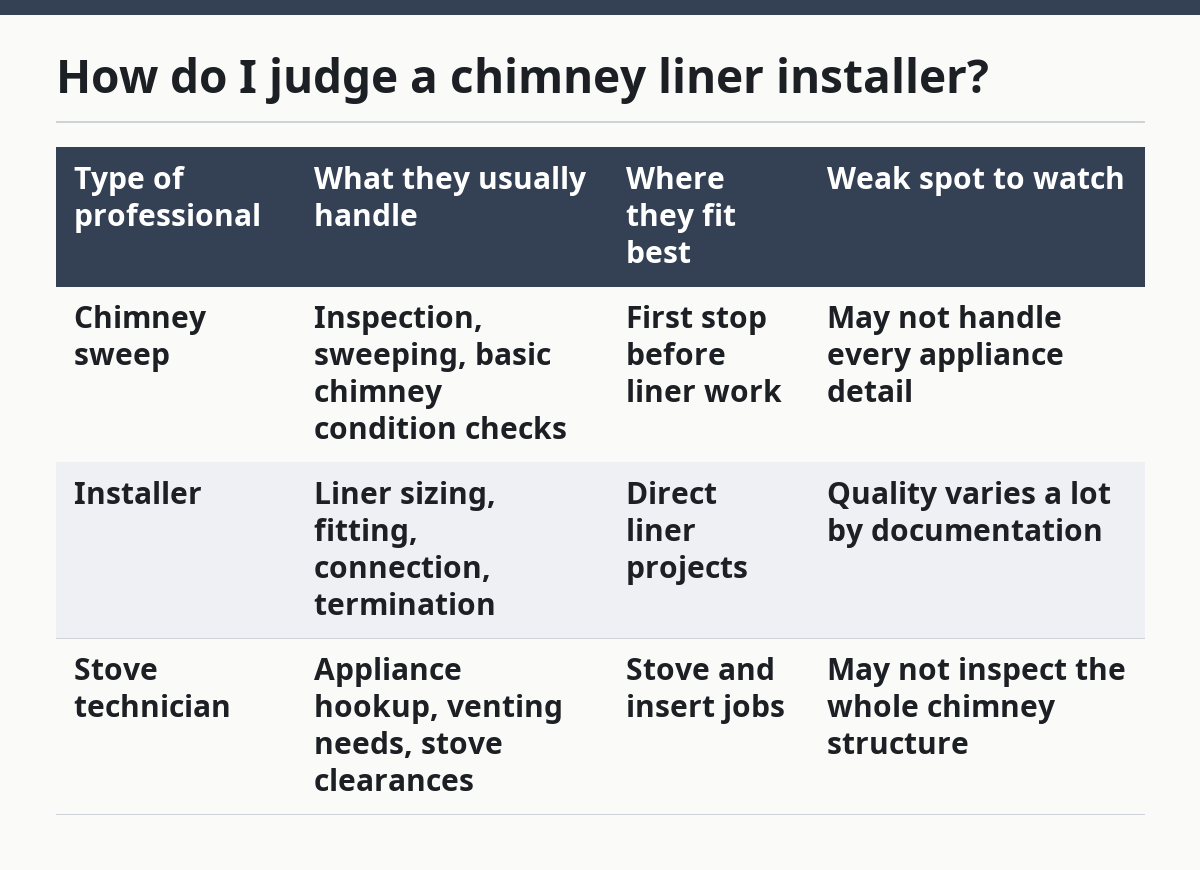
If you are choosing between people who all say they “do liners,” ask who will do the chimney inspection before work starts and who will sign off on the finished job. The one who can answer that clearly is often the safer bet. This also belongs under the regulations-and-buying-decisions hub on chimneylinerguide.com, because the choice is partly about compliance, not just price.
What credentials matter most?
The most useful credentials are the ones that show training, insurance, and code awareness, not just a logo on a van. A chimney liner installer should be able to name the standard they work to, talk about venting and flue sizing, and show that they carry the right insurance for work on your property.
One credential is not enough by itself. A badge may show training in chimney work, but the real test is whether the installer can connect that training to your chimney type. For example, a masonry chimney, a metal chimney, and an appliance vent all call for different checks before a liner goes in.
Look for three things in the conversation and the paperwork:
- Training or trade membership that is current enough to matter.
- Insurance proof that covers the job and the property.
- A direct answer about standards, especially NFPA 211 or the local code the installer follows.
Ask whether the installer does only liner work or also handles sweeping and inspection. If the answer is “both,” that can be useful because one person can see the whole system. If the answer is “only liners,” that is not a deal-breaker, but the installer should still show how they coordinate with an inspection before work begins.
This is also where an installer can go wrong. A person who pushes the job hard but cannot explain why the chimney needs a certain setup is risky. A person who says “we do this all the time” without naming the inspection step is not enough for a job that affects smoke path, draft, and safety.
Two standards organizations are worth knowing by name: NFPA for code guidance and the Chimney Safety Institute of America (CSIA) for chimney-related training. I would not pick someone just because a certificate exists, but I would treat these names as a baseline, not a luxury, and you can verify them through the organizations themselves before you hire. See NFPA 211 and CSIA for background on standards and training: NFPA 211, CSIA.
How should the estimate be written?
The estimate should be written so a person can tell what is included, what is excluded, and what happens if the chimney inspection shows a hidden issue. A vague quote is one of the easiest ways to end up with a dispute later.
A good estimate names the work in plain language. It should say whether the price covers inspection, removal of old material if needed, liner installation, connection parts, termination at the top, and cleanup. It should also spell out what is extra, such as repair work found after the chimney is opened up.
Ask for the estimate in writing before any date is booked. A phone quote is not enough for a chimney liner job because the work changes depending on what the inspection finds. If the installer refuses to write down the scope, walk away.
Watch for these gaps:
- No mention of the inspection level or timing.
- No list of parts.
- No statement about what happens if the chimney condition is worse than expected.
- No clear note about permit responsibility, if one is needed.
- No written timeline for starting and finishing the job.
A strong estimate also names the appliance type. A liner set up for a fireplace is not the same as one set up for a stove or insert. If the quote says only “install liner,” that is too thin for a job where the vent path matters.
I would be cautious of any estimate that looks too short to explain the work. One page can be fine if it is precise. One paragraph is usually not enough. The goal is clarity that survives a dispute.
What does a good inspection process look like?
A good inspection process starts before the installer brings a ladder, and it ends only after the liner and connection points have been checked against the chimney’s condition. The key marker is that the installer talks about inspection first and installation second.
The inspection should match the chimney’s condition and the planned use. A basic look may not be enough if the chimney has damage, a change in appliance, or evidence of past venting problems. In many cases, the installer should explain whether a more detailed inspection is needed before the liner choice is fixed.
Here is the core process I would expect in order:
- Inspect the chimney for size, condition, and signs of damage before any liner is sold.
- Measure the flue path and note bends, offsets, and termination details that affect fit.
- Match the liner plan to the appliance type and venting needs instead of guessing from the outside.
- Review the chimney connection points so the installer knows where fittings and transitions will land.
- Document the result so the work order and final job match the inspection findings.
Each of those steps changes the job. A chimney with a hard offset is not the same as a straight run. A stove connection is not the same as a fireplace connection. A chimney that looks fine from the ground can still have a problem that affects the liner choice.
This is where a chimney sweep or stove technician may help, but only if the person is willing to document what was found. The installer you want does not rush past the inspection to get to the sale. The installer explains why the inspection matters and what it changed.
How do warranties and insurance change the choice?
They change the choice because they tell you who carries risk if something goes wrong. If the installer cannot show insurance or will not explain the warranty in writing, the job is too exposed.
Ask for proof of insurance before booking. The person doing the work should carry coverage that fits chimney work on a home, not a vague promise that “we are covered.” If the answer is evasive, that is a red flag. The same goes for warranty language that sounds broad but says little.
A real warranty question is not “Do you have one?” It is “What is covered, for how long, and what voids it?” The installer should be able to answer in direct terms. If the answer depends on verbal promises, that is weak.
It also helps to separate the parts of the job that can fail. The liner itself may have one warranty. The labor may have another. The connection work, top support, and finishing details may fall under different terms. If the installer cannot explain that split, the paperwork may not help when you need it.
This matters for safety and for money. A poor connection, bad sizing, or sloppy termination can create a second repair job. That is why I would favor the installer who gives a clear warranty and does not overpromise. A short, honest warranty is better than a huge promise that is impossible to enforce.
Do not treat insurance as a bonus. For chimney liner work, it is part of the hiring decision. A lower bid loses its shine fast if the installer has no clear answer on coverage, and you can verify insurance requirements through your insurer or local licensing office before work starts.
What should I ask before I sign?
You should ask short, direct questions and make the installer answer them without sales language. These questions can help separate a careful professional from someone who is guessing.
What did the chimney inspection show?
The installer should be able to point to the condition of the chimney and say why the liner choice fits it. If the answer is vague, the job may be built on assumptions.
Who handles the inspection, and who installs the liner?
Sometimes one person does both. Sometimes a chimney sweep inspects and an installer does the work. Either can be fine, but the handoff should be clear before the appointment.
What standard do you work to?
The installer should be able to name NFPA 211 or the local code approach being used. If the person cannot name any standard, that is a bad sign. See the NFPA code page for background: NFPA 211.
What is included in the written estimate?
The answer should cover the scope, parts, cleanup, and any likely extras. A written estimate with clear exclusions is better than a cheap quote with surprises.
What does the warranty cover?
The installer should say whether the warranty covers parts, labor, or both, and for how long. If the answer changes from sentence to sentence, stop there.
A final check is simple: ask whether the installer is comfortable putting all of this in writing. Good professionals usually are.
Which installer is not the right one for me?
The wrong installer is the one who skips the inspection, hides the paperwork, or pushes the job before the chimney has been checked. That person is not right for a home with an older chimney, a stove connection, or any case where the vent path is not obvious.
I would also pass on anyone who treats insurance as a nuisance or a warranty as a sales trick. Those are not small details. They are the only protection you have if the job is not done the way it should be.
Because the liner work sits between the chimney, the appliance, and the home, a careful installer knows that the first job is not to sell a liner. The first job is to make sure the liner is the right answer for the chimney in front of them.
Key takeaways
- Pick the installer who starts with an inspection, not a price pitch.
- Ask for written proof of insurance and a plain-language warranty.
- Favor people who can name the standard they work to, such as NFPA 211.
- A clear estimate should show scope, exclusions, and what happens if the chimney condition changes the job.
- A chimney sweep, installer, and stove technician can each play a role, but the person you hire should explain where their role begins and ends.
Drafted with AI; not yet reviewed by a person.

Related Posts

Chimney Liner Codes and Safety Requirements
How to Choose a Chimney Liner for Your Appliance