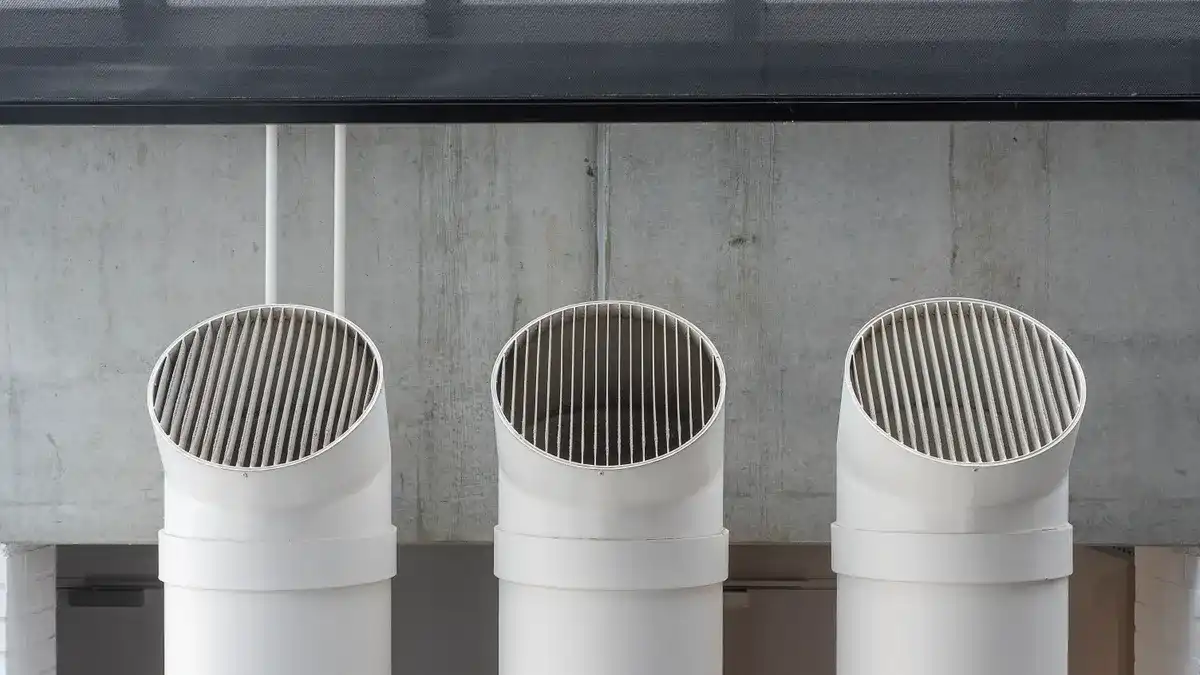
Chimney Liner Materials and Product Choice
Last updated: November 15, 2026
Quick Answer: for most wood, oil, and many gas appliances, stainless steel is the default liner material; aluminum is only for some low-heat gas venting jobs, and clay tile or cast-in-place systems fit specific masonry chimney conditions. In other words, chimneylinerguide.com materials and product choice — The Complete Guide starts with heat, fuel type, and the chimney’s condition, not with the brand name on the box. For a plain-English baseline on code and venting, I also point readers to NFPA 211 and EPA Burn Wise.
Key takeaways
- Stainless steel is often the safest default when the chimney has to handle heat, condensation, and real-world use.
- Aluminum is narrower in scope; it belongs only where the appliance and venting conditions allow it.
- Clay tile is not a universal upgrade. It can work in some masonry chimneys, but damage and size mismatch are common reasons it is replaced.
- Cast-in-place systems make sense when the chimney shell needs repair as much as the flue path does.
- The material is only half the decision. Diameter, fuel type, insulation, and the chimney’s condition can change the right answer.
What material should I choose?
Choose the material that matches the appliance first, then match the chimney’s condition second. That order matters because a liner that looks durable can still be the wrong product if it does not handle the fuel, the draft, or the heat.
For most homeowners, the choice narrows fast. Stainless steel is the broadest option because it is used across wood stoves, fireplaces, oil appliances, and many gas systems. Aluminum is a narrower product choice and belongs only where the appliance manual and venting rules allow it. Clay tile is part of many older masonry chimneys, but it is not the right answer when the existing tile is cracked, oversized, or too hard to clean. Cast-in-place liners are the structural repair option when the flue wall itself needs restoration, not just a new metal tube.
Because fuel type drives the decision, the practical test is simple: wood usually pushes the choice toward stainless steel, low-heat gas may allow aluminum, and damaged masonry often points to a structural solution. The material is the response to the chimney’s condition, not a style preference.
The most useful way to think about liner materials is this: heat, moisture, and flue gas chemistry decide the winner. Wood creates soot and creosote. Oil can create acidic condensation. Gas often runs cooler, but that does not make every metal liner acceptable. A wrong material can corrode, fail draft, or become a code problem under inspection.
Specifically, the safe choice is the one that matches the appliance manual, the flue size, and the chimney’s actual condition. A 6-inch liner, for example, is not automatically correct just because the old chimney looks large enough.
Stainless steel chimney liners: who should use them?
Stainless steel usually wins for most people because it covers the widest range of fuels and chimney conditions. It is the default recommendation when the job has to work with wood, oil, or many gas appliances and still hold up to heat and condensation.
The strongest case for stainless steel is flexibility. A stainless liner can be used when the chimney is lined with clay tile, when the old flue is too large for the appliance, or when a damaged flue needs a new continuous passage. It is also the material many readers will see associated with inspection-friendly retrofit work because it is built to meet the expectations of standards such as UL 1777 when properly listed and installed. That standard matters more than marketing language.
Because stainless steel can be insulated in many installs, it also gives more room for better draft. Insulation is not just a comfort feature; it helps keep flue gases warmer and supports draft. That matters in tall exterior chimneys, older masonry chimneys, and homes where the liner passes through cold attic or outside wall sections.
The weakness is cost and fit. Stainless can be more expensive than aluminum, and the wrong alloy can shorten service life in the wrong application. Some jobs need 316 or 316Ti stainless because the fuel or vent conditions are harsher than a basic stainless grade can handle. That means a buyer who picks by price alone can end up with a liner that is acceptable on paper but wrong for the appliance. Another drawback is installation complexity, especially when the chimney has tight bends, offsets, or a badly damaged flue.
Therefore, stainless steel is not the best choice for someone who only needs a simple low-heat gas vent and has a clear code-approved path for aluminum. It is also not the cure for a chimney that has structural brick or crown damage unrelated to the flue path; in that case, consult a qualified chimney professional and follow the repair guidance that fits the masonry condition, not just the liner.
When does aluminum make sense?

Aluminum makes sense only for the narrow gas-appliance cases where the appliance manual and local code allow it. It is not the universal “lighter stainless” option, and it should not be treated that way.
The main advantage is that aluminum can be a simpler answer for some lower-temperature venting jobs. If the appliance is specifically listed for aluminum venting, and the chimney conditions are compatible, it can be a practical product choice. That narrower role is its real strength. In a low-heat gas setup, paying for heavier material and more complicated construction can be unnecessary if the rules do not require it.
The weakness is just as important: aluminum has a much smaller use case. It is not the material a homeowner should assume will work with a wood stove, a fireplace insert, or any hotter appliance. It also does not belong where corrosive condensate, excessive heat, or code restrictions push the job beyond its limits. That means the margin for error is small. A buyer who picks aluminum because it sounds economical can end up replacing it sooner, or worse, facing an installation that should never have been approved.
Because the chimney itself may also be the problem, aluminum is a poor choice when the stack has broader damage. A damaged masonry stack, a flue with a history of creosote buildup, or a system with uncertain appliance compatibility usually calls for stainless steel or a structural liner solution instead. A cheap material is not a smart buy if the line between “allowed” and “not allowed” is thin.
This is the material to consider when the venting job is simple, the heat is lower, and the appliance documentation clearly points in that direction. If any of those conditions are unclear, aluminum is the wrong bet.
The honest side-by-side
Stainless steel is the better all-around choice; aluminum is the narrower choice that only wins when the appliance makes it safe and legal. The table below shows the differences that actually change the decision.
| Criteria | Stainless steel | Aluminum | Winner for this condition |
|---|---|---|---|
| Fuel types | Works with wood, oil, and many gas appliances when properly listed | Limited to some gas venting applications | Stainless steel for mixed or uncertain fuel use |
| Heat tolerance | Better fit for higher flue temperatures | Lower-heat use only | Stainless steel for wood and oil |
| Corrosion resistance | Stronger choice for tougher vent conditions | More limited durability margin | Stainless steel for damp or acidic venting |
| Code flexibility | Broadly used in retrofit work and listed systems | Narrower approval window | Stainless steel for inspections and retrofits |
| Insulation options | Commonly paired with insulation | Less often the right answer | Stainless steel for exterior chimneys |
| Chimney condition | Better when the flue is damaged, oversized, or uneven | Better only in simpler, compliant cases | Stainless steel for imperfect chimneys |
| Installation scope | Handles more repair scenarios | Fewer repair scenarios | Stainless steel for most replacement jobs |
| Cost pressure | Usually the higher-spec choice | Often the lighter-duty choice | Aluminum only when the appliance allows it |
| Long-term margin | Better safety buffer across changing use patterns | Less margin if conditions change | Stainless steel for future-proofing |
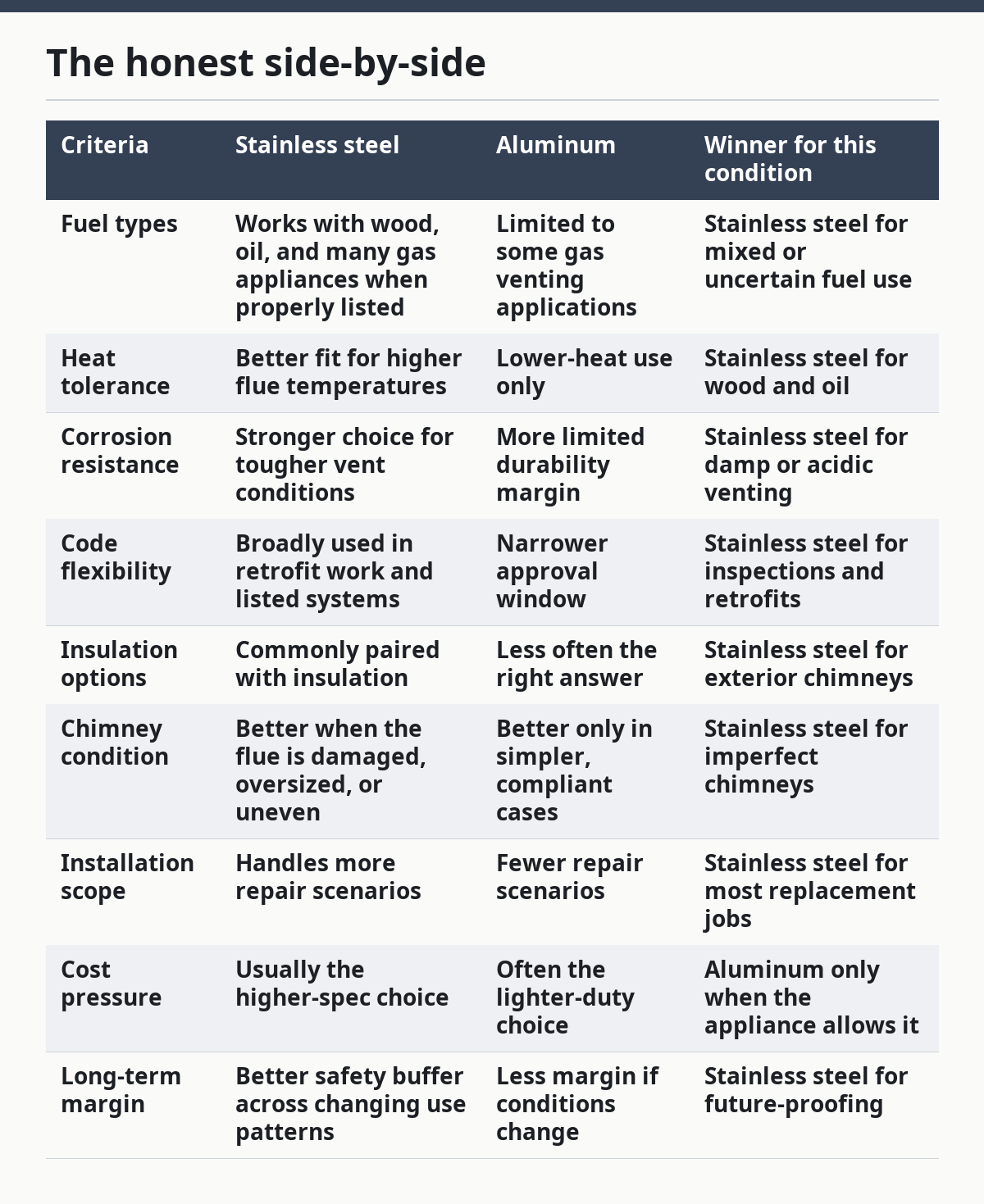
The table makes one thing plain: stainless steel is the default because it solves more real chimney problems. Aluminum is not a lesser version of stainless in a general sense; it is a different tool with a much smaller use case.
That distinction matters because many readers are not buying a liner for a perfect new build. They are replacing something old, cracked, undersized, or uncertain. In those cases, the broad tolerance of stainless steel is the point. Aluminum only becomes the better answer when the whole system is already simple and the appliance manual points there without hesitation.
What else changes the right choice?
Diameter, insulation, and chimney condition can matter as much as the material itself. A 6-inch liner and an 8-inch liner do not behave the same way, even when they are made from the same metal.
Diameter is the first detail that changes the outcome. A liner that is too large can cool flue gases too much and hurt draft. A liner that is too small can choke the appliance and cause performance or safety problems. That is why product choice is not just “stainless versus aluminum.” It is also “which size, for which appliance, in which chimney.” The right answer often comes from the appliance manual, the flue dimensions, and the chimney’s actual interior path.
Specifically, insulation is the second detail. In many retrofit jobs, especially on exterior chimneys, insulation helps the liner keep flue gases warmer. That can improve draft and reduce condensation. It also matters because a bare liner in a cold masonry chase is not the same system as an insulated liner in the same chase. Two products with the same metal can behave very differently.
The chimney’s condition is the third detail, and it is where a lot of generic advice fails. If the clay tile is cracked, if the flue has a major offset, or if the chimney crown and masonry are failing, the material choice may be only part of the repair. Stainless steel can solve the flue path. It cannot repair a leaning stack or a broken crown by itself. Clay tile replacement can make sense in some rebuilds, but only if the existing chimney structure is worth saving. Cast-in-place systems come into the picture when the structure and the flue both need attention.
Because of that, the practical test is simple: if the chimney is only a vent path problem, a liner material choice may be enough. If the chimney is a structural problem too, the material choice needs to be part of a bigger repair plan.
Which product fits my appliance?
The appliance manual should decide the product before the brand name does. That is the cleanest way to avoid buying the wrong liner material for the wrong fuel.
For a wood stove or fireplace insert, stainless steel is usually the material to start with. Wood heat creates soot and creosote, and the liner has to tolerate regular high heat, cleaning, and the chance of condensation during startup or shoulder-season use. A stainless system also gives more room for future changes, which matters when a homeowner may switch appliance models later.
For many gas appliances, the answer can be stainless steel or aluminum, but only if the listing and local rules allow it. Gas sounds simple, yet it can still create condensation and corrosion, especially in cooler chimney runs. That is why “gas” is not enough detail. The appliance type, vent temperature, and required vent material all have to match.
For oil appliances, stainless steel usually has the stronger case because oil venting can be harsher on materials than a basic low-heat gas job. A clay tile chimney with oil soot still deserves attention, but a weak liner material is not the place to save money.
Because a deteriorated chimney may need more than a tube, the product choice changes again when the flue is badly damaged. If the flue is cracked along much of its length, a cast-in-place solution may fit better than a simple metal liner. If the issue is a deteriorated clay flue in a masonry chimney that still has sound structure, a stainless steel liner can be the cleaner retrofit. The point is not to pick a material first and then look for a use case. The appliance and the chimney decide the material.
The wrong choice is usually obvious in hindsight. It is the liner that looked acceptable in a catalog but ignored the appliance manual, the flue size, or the condition of the chimney wall. That is the mistake to avoid.
When should I rethink the whole setup?
Rethink the whole setup when the chimney damage is structural, the appliance is unclear, or the liner material cannot satisfy code. In those cases, a material choice alone is too small to solve the problem.
The first exception is a chimney with widespread masonry damage. If the stack is failing, the crown is broken, or the flue path is not the only problem, a liner material decision is not the main issue. The chimney may need rebuilding, not just relining. In that situation, even a quality stainless liner is only one piece of the repair.
The second exception is an appliance with uncertain compatibility. If the appliance manual does not clearly allow a material, or if the venting path has been modified over time in ways nobody can explain, stop and verify. A 6-inch liner is not the answer to an unknown venting problem. The correct answer may be a different material, a different diameter, or a different appliance altogether.
The third exception is a chimney that is too oversized for the appliance. In that case, the liner size and insulation strategy become as important as the metal. A liner that is technically allowed can still perform badly if the flue is too large for the appliance’s output. That is a system issue, not just a product issue.
The fourth exception is a house where the use pattern may change. A homeowner who may switch from a gas insert to a wood stove later should think ahead now. Aluminum may look fine for the current setup, but it does not future-proof the chimney. Stainless steel often does.
There is a plain rule here: if the system is simple and clearly listed, the material choice is easy. If the system is damaged, oversized, modified, or uncertain, the material choice is only the start of the conversation.
What is the verdict?
Choose stainless steel if you need one liner that can handle wood, oil, or a broad range of gas venting jobs, or if the chimney is old, oversized, or partly damaged. Choose aluminum if the appliance is a low-heat gas system and the manual and code both allow that material. Neither if the chimney has major structural damage or the venting path is so unclear that the liner would be a guess.
That is the cleanest call I can give. Stainless steel is the safer default because it covers more real-world chimney jobs and leaves more margin for error. Aluminum is the narrower, conditional choice. It is useful, but only in the right lane.
FAQ
Can I use a cheaper liner material if the chimney “looks fine”?
No, because a chimney that looks fine from the outside can still be wrong for the appliance inside it. The decision turns on fuel type, flue size, vent temperature, and the chimney’s internal condition, not just appearance. A 6-inch or 8-inch liner can be the wrong product if the material itself does not match the job.
Is stainless steel always better than aluminum?
No, because better depends on the appliance and the venting rules. Stainless steel is the broader, safer default, but aluminum can be acceptable in some low-heat gas applications when the listing and code allow it. The wrong material is not “cheaper”; it is simply wrong for the system.
Do I need insulation with a stainless steel liner?
Not always, but many retrofit jobs benefit from it. Insulation can help keep flue gases warmer, which supports draft and reduces condensation, especially in exterior masonry chimneys. The chimney’s location, the appliance, and the flue size all affect whether insulation is the smart choice.
Is clay tile a good liner material?
Clay tile can be part of a sound masonry chimney, but it is not a universal upgrade. Cracks, gaps, or major size mismatch can make it a poor choice for a retrofit. In those cases, stainless steel or cast-in-place repair is often the more practical answer.
When should I stop comparing materials and call the whole chimney into question?
Stop when the chimney has structural damage, a badly oversized flue, or an appliance situation that does not clearly match any listed liner material. That is when the job shifts from “which liner should I buy?” to “does this chimney need repair or rebuilding?” A liner alone cannot fix every chimney problem.
Drafted with AI; not yet reviewed by a person.

Related Posts
Stainless Steel vs Clay vs Aluminum Chimney Liners
Flexible vs Rigid Chimney Liners

2 thoughts on “Chimney Liner Materials and Product Choice”