Chimney Liner Codes and Safety Requirements
Last updated: November 17, 2026
Quick answer: chimney liner code requirements usually turn on 3 things — the adopted code, the appliance listing, and the local inspection path. Chimney liner code requirements depend on the building code, the fire code, and local amendments, but the safe rule is simple: the liner must match the appliance, stay listed for the job, and be installed with the right clearances and inspection sign-off. If a wood stove or gas appliance is tied to the wrong liner, the problem is not just paperwork; it can become a venting and fire hazard.
Key takeaways
- A liner is not judged by one rule alone. Building code, fire code, and local amendments all matter.
- The appliance must be listed for the venting system it uses. A wood stove and a gas appliance are not treated the same way, so a qualified chimney professional or local code official should confirm the match. NFPA 211
- Clearance, termination, and connector details matter as much as the liner material itself.
- An inspection can be the difference between a code-compliant installation and a red-tagged one.
- When local rules are stricter than the base code, the local rule wins.
What code applies to chimney liners?
The code that applies to chimney liners is usually a mix of the local building code, the local fire code, and the model code or standard adopted in that area. In many places, the big names are NFPA 211 and the International Mechanical Code, with local amendments layered on top.
A chimney in one town can be treated differently from the same chimney in the next county if the local authority has amended the base code, so a qualified chimney professional or local code official should verify the adopted rule for the specific address. The practical test is not “What does the internet say?” but “What does the code enforcement office in this jurisdiction require for this appliance and vent system?” NFPA 211 ICC IMC
A reader trying to sort this out should start with the exact appliance type: wood stove, fireplace insert, gas appliance, oil unit, or another vented device. Those categories matter because the code language changes with the fuel and the venting method. A gas appliance may be governed by different liner and vent rules than a wood stove connected to a solid-fuel chimney.
The cleanest way to think about it is this: the chimney liner is part of a system, not a standalone product. The building code usually handles the broad installation rules, the fire code handles fire safety and use, and local amendments can tighten both. If the liner, appliance, and chimney do not agree with the adopted standard, the installation can fail inspection even if it looks fine from the roof.
For a closer look at the standards side, NFPA 211 is the main reference many inspectors and installers use for chimneys, fireplaces, vents, and solid-fuel appliances. The International Mechanical Code also comes into play where it has been adopted for venting work.
What does chimney liner code require for clearance and listing?
Chimney liner code requires the liner and its installation to match the listing, the appliance, and the chimney construction. “Listed” means the product has been approved for a specific use, and that use controls the way it can be installed.
This is where many homeowners get tripped up. A liner made for one venting condition is not automatically legal for another. A liner used with a wood stove is not judged the same way as a liner used with a gas appliance. Because of that, a qualified chimney professional should confirm the full assembly, not just the liner material. The code cares about the whole assembly: liner material, connector parts, termination, and the chimney space around it.
The safety side is straightforward. The liner has to keep combustion products contained and move them out of the home without overheating nearby framing or masonry. Clearances matter because heat transfer is the hidden risk. If a liner or connector sits too close to combustible material, the installation can become unsafe even if the appliance itself is listed.
A code-compliant liner setup also needs the right termination at the top. The termination has to suit the venting system and keep rain, debris, and improper draft problems from entering the flue path. At the firebox or appliance connection, the parts have to fit together as part of one listed system, not as a pile of separate pieces.
Here is the core procedure a homeowner or buyer can use before a job moves forward:
- Identify the appliance on the rating plate or manual. Note whether it is a wood stove, gas appliance, or another listed unit, because that choice drives the venting rules.
- Check the adopted code for the property. Ask the local authority whether NFPA 211, the International Mechanical Code, or another code set controls the work in that jurisdiction.
- Match the liner to the appliance listing. The liner, connector, and termination must all be approved for the same venting use.
- Confirm the chimney construction and any clearance limits. Masonry, factory-built chimney, and framed enclosure conditions can change the required details.
- Plan for inspection before use. A chimney sweep or other qualified inspector can verify the vent path, connection, and termination before the appliance is fired.
The cost of skipping this order is usually inspection failure or a system that has to be rebuilt. The better move is to treat the code as a design checklist before any parts are bought, and to confirm the plan with a qualified chimney professional or local code official. (Source: NFPA 211)
How do appliance listing and venting rules fit together?
Appliance listing and venting rules fit together by design, not by guesswork. A wood stove, gas appliance, and other vented devices each have their own approved venting limits, and the liner must stay inside those limits.
A common mistake is to think the liner alone makes the system safe. It does not. The appliance listing tells you what the unit is allowed to connect to, how it can be vented, and what parts can be used with it. If the liner material or connector setup falls outside that listing, the installation can be out of code even if the chimney itself is clean and sound.
The other common mistake is mixing fuel types without checking the venting rules. A wood stove has different combustion characteristics than a gas appliance. That difference changes draft, flue gas temperature, and the parts that are allowed to carry exhaust.
A code-compliant liner setup has to reflect the fuel, the appliance label, and the venting path. A sweep or installer should verify the appliance manual against the adopted code before work starts, not after the parts are already on site.
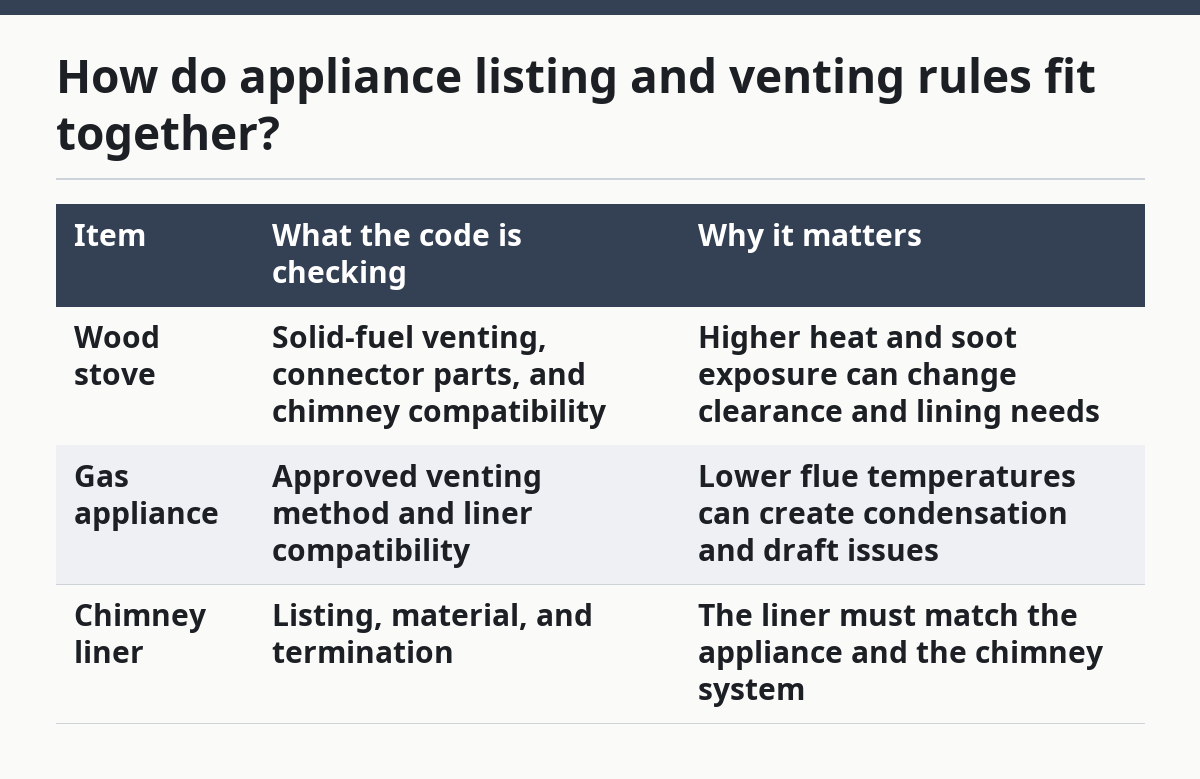
A simple comparison helps.
| Item | What the code is checking | Why it matters |
|---|---|---|
| Wood stove | Solid-fuel venting, connector parts, and chimney compatibility | Higher heat and soot exposure can change clearance and lining needs |
| Gas appliance | Approved venting method and liner compatibility | Lower flue temperatures can create condensation and draft issues |
| Chimney liner | Listing, material, and termination | The liner must match the appliance and the chimney system |
This is also where a chimney sweep adds real value. A sweep is not just clearing soot; a competent sweep can spot venting mismatches, loose connector parts, or signs that the liner and appliance are not matched to the code path. That matters more than whether the chimney “looks okay” from the ground.
If the appliance manual and the code disagree, the safer reading is to follow the stricter rule until the local authority says otherwise. A homeowner should never assume a wood stove or gas appliance can share the same venting assumptions just because both run into a chimney.
What inspection and local amendment checks should you do?
Inspection and local amendment checks should happen before the liner is used, not after. The safest approach is to confirm the adopted code, any local amendments, and the inspection requirement before the first fire, then have a qualified chimney professional or local code official review the plan if anything is unclear. (Source: ICC IMC NFPA 211)
That matters because local rules can be stricter than the base standard. One town may accept a setup that another town rejects. The authority having jurisdiction can ask for a permit, a final inspection, or both. If a homeowner skips that step, the system can be left in a gray area where it is installed but not approved.
The best check is the boring one: ask what document governs the job, then ask what the inspector wants to see. That usually includes the appliance type, the liner listing, the chimney construction, and the clearance details. A chimney sweep may also be asked to document cleaning or condition before the appliance is returned to service.
A good inspection also looks for signs that the liner path is wrong for the fuel. With a gas appliance, condensation and vent compatibility are the concern. With a wood stove, heat, soot, and clearance become the bigger issues. The inspection is where those differences get judged against the code, not against guesswork.
Use this short checklist before anyone fires the appliance:
- Confirm the local code set and amendments.
- Confirm the appliance label and venting instructions.
- Confirm that the liner is listed for that use.
- Confirm the chimney and connector clearances.
- Confirm the final inspection requirement and approval path.
That checklist is simple, but it catches the failures that matter. A code-compliant chimney liner is not just a part number; it is a documented match between appliance, vent, and jurisdiction.
If you need the broader rules that sit behind this page, the regulations hub on chimneylinerguide.com covers the buying and compliance side in one place.
What are the safety mistakes people make most often?
The biggest safety mistakes are using the wrong liner for the appliance, ignoring local amendments, and treating a quick visual check as proof of compliance. Those mistakes can lead to failed inspection, draft problems, and heat damage where the chimney passes through the house, so a qualified chimney professional should verify the system before it goes into service. (Source: NFPA 211)
A second mistake is assuming every chimney sweep or contractor is checking the same code details. A sweep can clean and inspect a flue, but the code question is still separate from the cleaning question. The job may be clean and still not meet the adopted standard for that 2024 or 2025 code cycle in the area.
Another mistake is confusing a listed product with a code-compliant installation. Listing matters, but it is only one piece. The appliance, connector, termination, and chimney structure all have to work together. If one piece is off, the whole system can fail the code test.
The cost of these mistakes is not abstract. It can mean extra labor, replacement parts, delayed use of the appliance, or a system that cannot legally be put into service until it is corrected. The better path is slower at the start and cheaper at the end.
Who this is not for: anyone looking for a one-size-fits-all answer that skips the appliance manual, local code, or inspection process. Chimney liner code is not a “close enough” topic. It is a system match topic.
When should a pro be involved?
A pro should be involved whenever the local code is unclear, the appliance is new to the house, or the venting path changes from the original setup. That is especially true for wood stove and gas appliance conversions, where the listing and venting rules can differ sharply.
This is one of the few home topics where guessing is a bad bet. A qualified chimney sweep, installer, or local code official can tell you whether the liner plan fits the adopted standard and the appliance instructions. In many cases, that check is faster than redoing a failed installation later.
The safest trigger is simple: if you cannot point to the exact code, the exact listing, and the exact inspection path, stop and ask. That is not overcautious. It is the normal way to avoid a noncompliant venting system.
For the standards side, NFPA 211 is the main reference many people start with, and your local fire code office can tell you what was amended or adopted on top of it. The point is not to memorize the whole book. The point is to make sure the liner, appliance, and chimney all belong together before the first fire.
What code applies to chimney liners?
Chimney liner code usually comes from the local building code, the fire code, and the standards adopted in that area, such as NFPA 211 or the International Mechanical Code. The exact rule depends on the jurisdiction, so local amendments can change the answer even when the chimney and appliance look ordinary. (Source: NFPA 211 ICC IMC)
Are chimney liners required by code?
Chimney liners are not answered by one universal rule because the requirement depends on the appliance, chimney type, and local code adoption. In many cases, the liner is required when the venting system or appliance listing says it must be there, or when the chimney needs a listed liner to meet clearance and safety rules.
What are the safety requirements for a chimney liner?
The safety requirements are that the liner must be listed for the appliance, installed with the correct clearances, and connected as part of a compliant venting system. It also has to pass whatever inspection the local authority requires, and it must work with the wood stove, gas appliance, or other unit it serves.
Drafted with AI; not yet reviewed by a person.

Related Posts
How to Choose a Chimney Liner Installer
How to Choose a Chimney Liner for Your Appliance