How much does a chimney liner cost?
Last updated: November 15, 2026
Quick answer: a chimney liner cost is best read as a project price, not just a part price. The liner itself is only one part of the bill, and the final cost depends on chimney height, the liner type, the insulation kit, and how hard the installation is for the installer.
Key takeaways
- The liner material is only one line on the estimate; labor often changes the total more than the part itself.
- A taller or harder-to-access chimney usually costs more because the job takes longer and needs more setup.
- An insulation kit can add cost, but it can also be part of a proper installation, not an optional extra.
- Replacement work can cost more than a first-time install if the old liner has to be removed first.
- A low quote is not always the cheaper choice if it leaves out labor, insulation, or cleanup, so it is worth checking the scope with a qualified chimney professional and reviewing guidance such as NFPA 211 and the Chimney Safety Institute of America.
What drives the chimney liner cost?

Therefore, the chimney liner cost is driven by four things: material, labor, insulation, and installation complexity. A stainless steel liner is only one piece of the total, and the installer still has to size it, fit it, and connect it correctly. If the chimney has bends, damage, or access problems, the bill can climb even when the liner itself is simple. For code and installation context, consult a chimney professional and review NFPA 211 and CSIA.
Specifically, a generic article often misses the split between parts and labor. That matters because a homeowner may focus on the liner price and then feel shocked when the estimate includes removal, sealing, or an insulation kit. The job is not just “drop in a tube”; it is a fit-and-finish project that changes with the chimney.
Meanwhile, the job also changes with the condition of the old system. A replacement in a straight chimney is one thing; a replacement in a chimney that needs cleanup or repair is another. The same liner can cost more to install in one house than in the next because the chimney is the part that sets the pace.
Ultimately, if a reader only remembers one point, make it this: the cheapest liner part does not always make the cheapest project.
How much of the bill is the liner itself?
However, the liner itself is only part of the total, and the rest is usually labor and materials tied to the job. That means the quote should separate the chimney liner from the installation work, not bundle everything into a single mystery number.
For example, a stainless steel liner is a common line item on an estimate because it is often the main hardware people notice first. But the stainless steel liner is not the whole job. The installer still has to size the liner to the chimney, handle the route from top to bottom, and connect it to the appliance or flue opening.
Here is a simple way to read an estimate: if the numbers are unclear, consult a professional chimney installer and compare them against NFPA 211 and CSIA.
| Cost piece | What it covers | Who it is for | What to skip |
|---|---|---|---|
| Liner material | The chimney liner itself | A homeowner comparing part cost only | Do not treat this as the full project price |
| Labor | Fitting, connection, and setup | Anyone who wants the liner installed correctly | Do not assume labor is small on a difficult chimney |
| Insulation kit | Added insulation around the liner | Jobs that need a more complete install | Do not skip it just to save money if the installer says it is needed |
| Replacement work | Removal of the old liner or damaged parts | Older chimneys with an existing liner | Do not ignore removal if the old liner must come out |
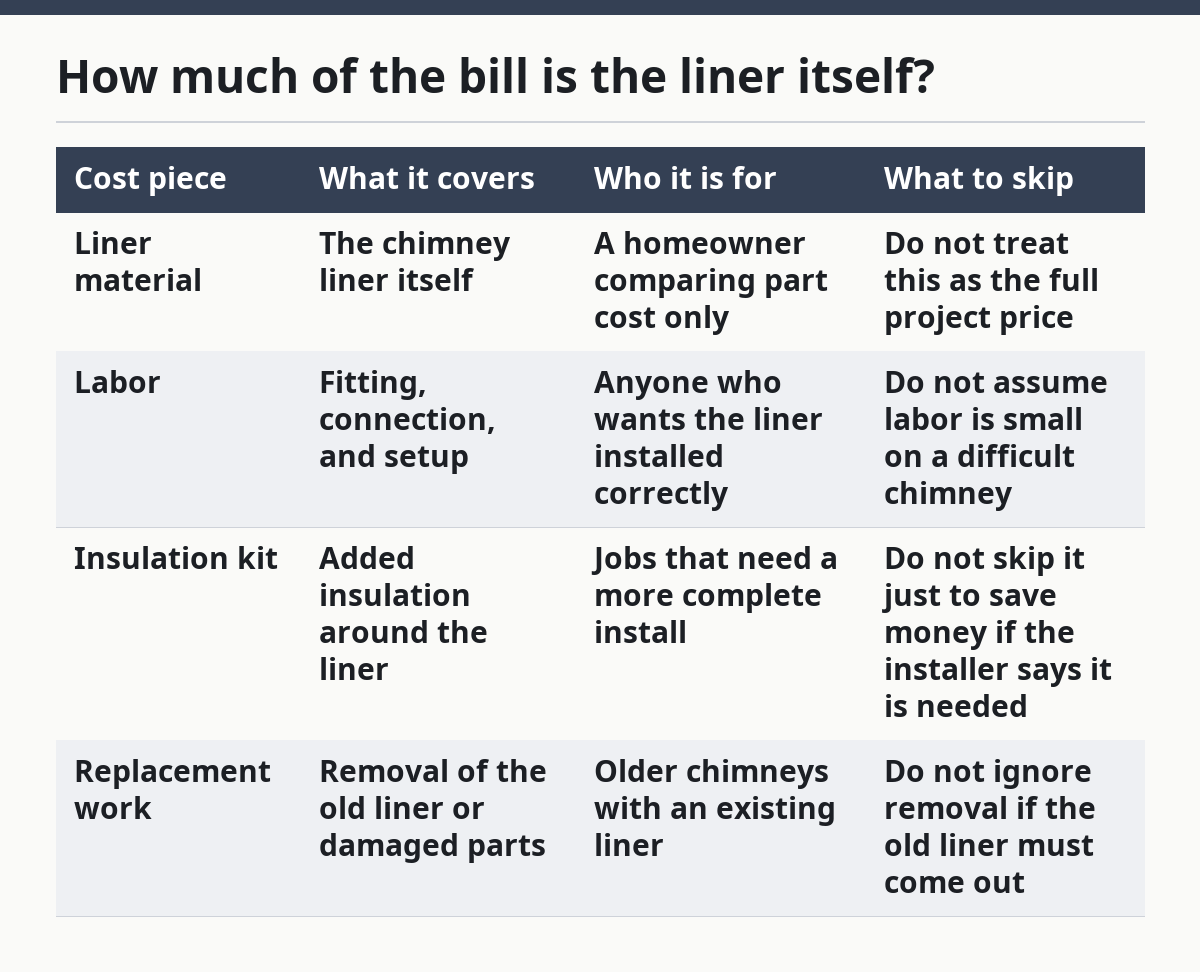
In short, the point of the table is simple: the liner price is real, but it is not the whole invoice. If a quote looks cheap, check what it leaves out. A homeowner comparing two estimates should look for the same scope on both lines, or the comparison is useless.
What does labor cost change?

Because labor cost changes the most when the chimney is awkward, tall, or already damaged, the estimate can move a lot from one house to the next. A straight, easy run usually takes less time than a chimney with bends, tight access, or cleanup work. An installer may also need extra setup time if the job requires roof access, careful sealing, or special handling for a stainless steel liner.
Therefore, a short estimate can hide the labor problem. If one installer quotes the liner and another quotes a complete installation, the numbers will not mean the same thing. That is why the labor line matters as much as the material line, and why a homeowner should ask a qualified pro to explain the scope before comparing bids.
After that, a homeowner should expect labor to rise when the work involves more than a basic swap. If the chimney sweep finds heavy debris, a cracked flue, or a blocked path, the install can take longer. That extra time is not cosmetic; it is part of making the chimney safe to use with the new liner.
In contrast, the biggest mistake here is treating labor as a flat fee. It usually is not. The installer is pricing time, access, and risk, and those three things can change fast from one chimney to the next.
Do you need an insulation kit?
Nevertheless, a chimney insulation kit can raise the price, but it can also be part of the correct installation. The kit is not just an upsell if the chimney setup calls for it. In many projects, the insulation is part of what helps the liner perform as intended, and that is why chimney liner insulation is often discussed alongside the liner itself.
This is where a low-cost quote can get misleading. A bare liner plus labor may look cheaper than a lined and insulated system, but the cheaper quote may not include the same scope. If the installer recommends an insulation kit, the homeowner should ask whether it is part of the normal install or an extra based on the chimney condition.
Because of that, the right question is not “Can I remove the insulation kit?” The better question is “What does the installer need for this chimney, and what happens if I leave it out?” That keeps the comparison honest. It also keeps the quote from changing later when the job is already underway.
Finally, an insulation kit is most worth discussing when the chimney is older, oversized, or otherwise hard to fit cleanly. If the chimney is straightforward and the installer says insulation is not required for that setup, the bill can stay lower. If the installer says it is needed, skipping it can create a false savings.
How much does replacement cost?
Since replacement cost is usually higher than a simple first-time liner job, the old liner may have to come out first. That adds labor, cleanup, and sometimes extra repair work before the new liner goes in. A replacement is not just “install again”; it can be a removal project first, and chimney liner replacement often brings that extra work into the estimate.
Older chimneys are the main reason replacement gets more expensive. If the old liner is damaged, stuck, or sized badly, the installer may need more time to clear the path. The job can also get more complex if the chimney has been patched before or if the previous install left behind seals or debris.
So, this is one of the places where a homeowner can save or overspend by mistake. If the old liner can be removed cleanly, the replacement may stay closer to a normal install. If the chimney needs repair around the liner, the total can move up fast. The estimate should say what removal is included and what is not, especially if the installer is quoting chimney liner removal as a separate step.
Because of that, a replacement quote should be read in pieces, not as one lump sum. Ask what part of the price covers removal, what part covers the new liner, and what part covers labor. That is the only way to compare two installers on equal terms, and it is the safest way to compare a replacement quote with a stainless steel chimney liner install.
How do I compare estimates without getting burned?
However, the cleanest way to compare estimates is to make sure each one covers the same scope, the same chimney, and the same materials. A quote for a stainless steel liner with an insulation kit is not the same as a quote for the liner alone. If one installer includes cleanup and another does not, the lower number can be a trap.
Use this order when reviewing a bid:
- Check whether the quote names the chimney liner, the installer labor, and the insulation kit separately. The result should be a line-by-line estimate, not one vague total.
- Confirm whether the price is for new installation or replacement. Replacement work often needs more time because the old liner has to come out first.
- Look for chimney-specific details, such as height, access, and any extra setup. Those factors usually explain why two bids differ.
- Ask whether the quote includes only the liner or the full job. A lower number may leave out removal, sealing, or cleanup.
- Compare only like for like. If one estimate is for a full replacement and another is for a partial fix, they cannot be judged on price alone.
In particular, a comparison that ignores scope is how people overpay. It is also how people choose the wrong job. The better quote is the one that tells the truth about what the chimney needs, even if the number is higher.
What should you skip?
Therefore, skip any estimate that hides the breakdown, skips the labor line, or treats insulation as a surprise add-on. A quote that does not say what the installer is doing is hard to trust. It may look lower, but it can turn into a bigger bill once the work starts.
Next, skip the idea that all chimney liner jobs are the same. They are not. A straight installation in a sound chimney is very different from a replacement with access problems or cleanup work. If the quote does not reflect that, it is not a useful quote.
Finally, skip the urge to judge the project by the liner alone. The liner matters, but the installer’s labor, the insulation kit, and the chimney condition usually decide the final price. That is the part most people miss when they search for “chimney liner cost” and expect one simple answer.
What is the practical answer?
Overall, the practical answer is that a chimney liner cost is best thought of as a project price, not a single product price. The liner, the labor, the insulation kit, and the replacement work all shape the total. If one of those parts changes, the estimate changes too.
As a result, the right way to shop is to ask for the full scope in writing. A homeowner should know whether the number covers only the liner, or the liner plus installation and any needed extras. The cheapest line on the page is not always the cheapest job in the end.
Ultimately, for many readers, the useful question is not “What does a chimney liner cost?” but “What is this particular chimney going to need?” That is the question an installer is really pricing.
Drafted with AI; not yet reviewed by a person.

Related Posts

Chimney Liner Codes and Safety Requirements
How to Choose a Chimney Liner Installer
3 thoughts on “How much does a chimney liner cost?”