How to Choose a Chimney Liner for Your Appliance
Last updated: November 16, 2026
To choose the correct chimney liner, match the liner material and construction directly to your appliance’s fuel type and exhaust temperature. For wood-burning stoves and fireplace inserts, choose a 316Ti or 304-grade stainless steel liner listed to UL 1777. For standard gas appliances, use aluminum or 316-grade steel, while oil appliances require 316Ti or 316L alloys to withstand sulfuric acid condensation.
Correct chimney liner selection helps reduce flue gas spillage, fire risk, and masonry decay; however, it should always be confirmed against the appliance listing and local code by a qualified professional. For local building codes, clearance mandates, and legal requirements, consult chimneylinerguide.com regulations and buying decisions and a licensed installer to ensure your installation meets municipal standards.
Key Takeaways
- Appliance fuel chemistry dictates the required liner alloy; mismatched metals often fail within two to five heating seasons.
- The cross-sectional diameter of the liner must equal the appliance exhaust collar to maintain adequate draft velocity.
- Solid fuel setups, including wood stoves and fireplace inserts, demand insulation blankets tested to withstand 2,100°F chimney fire conditions.
- High-efficiency heating systems generate acidic condensate that can dissolve conventional clay and light aluminum vents.
Step-by-Step Chimney Liner Selection
Follow these five practical steps to determine the exact liner required for your heating unit.
- Locate the appliance data plate. Check the metal specification plate riveted to the back or lower access panel of your furnace, boiler, or insert. Note the British Thermal Unit (BTU) rating, fuel specification, and the outside diameter of the flue collar.
- Examine the existing chimney passage with a high-lumen flashlight. Measure the internal clearance of the masonry flue from the roof crown down to the appliance intake. Verify whether a 1/2-inch insulation blanket wrapped around the outside of the prospective liner can physically pass through any interior masonry offsets or smoke chambers.
- Confirm the appliance venting category. Categorize gas appliances according to National Fuel Gas Code definitions (Category I through Category IV). Category I systems use natural draft with negative static pressure and non-condensing flue gas; Category IV units use forced draft with positive pressure and produce liquid condensate.
- Select the liner alloy grade based on fuel chemistry. Choose Type 304 stainless steel solely for dry, cord-wood burning; specify Type 316L or titanium-stabilized 316Ti for wood stoves, pellet units, and oil burners; select AL 29-4C superferritic stainless steel for Category IV high-efficiency gas appliances.
- Calculate the liner diameter against manufacturer collar sizing. Maintain a 1:1 ratio between the appliance flue outlet and the liner diameter. A 6-inch wood stove collar requires a continuous 6-inch inner diameter liner throughout the chimney structure.
What Type of Liner Does a Wood Stove or Fireplace Insert Need?
A wood stove or fireplace insert requires a continuous, stainless steel liner tested and certified to the UL 1777 standard. Because cord wood produces unburned hydrocarbons, water vapor, and organic acids, those byproducts can coalesce into creosote when flue temperatures drop below 250°F. If creosote catches fire, flue temperatures can spike to 2,100°F in minutes.
Solid-fuel appliances demand heavy-duty alloys capable of withstanding severe thermal shock. The two primary metal alloys used are:
- Type 304 Stainless Steel: Suitable exclusively for dry cord wood. It resists standard oxidation up to 1,500°F continuous exposure, but it provides minimal defense against the corrosive chlorides present in coal or processed fuels.
- Type 316Ti Stainless Steel: Formulated with molybdenum and titanium. The titanium helps stabilize the alloy at raised temperatures, and the material resists intergranular corrosion caused by high heat cycles, pitch accumulation, and acidic soot. It is the proper choice for modern, high-efficiency EPA-certified wood stoves and pellet units that experience wide temperature fluctuations.
Insulation is not an optional accessory for solid fuel. Building safety codes derived from NFPA 211 (Standard for Chimneys, Fireplaces, Vents, and Solid Fuel-Burning Appliances) state that chimney liners serving solid-fuel appliances must either maintain specified air space clearances to combustible materials or incorporate a tested insulation jacket. When permitted by the appliance listing and local code, wrapping a wood stove liner in a 1/2-inch, 8-pound-density ceramic fiber blanket can help preserve interior flue warmth, sustain draft, and keep external chimney masonry below combustible ignition points during a chimney fire event; consult a professional before installation.
How Do You Vent a Gas Furnace Safely?
A gas furnace requires a chimney liner material selected strictly according to its operating efficiency and the resulting temperature of its exhaust stream. Natural gas and propane produce substantial water vapor during combustion, so the vent system must be sized and listed to manage moisture safely.
Mid-efficiency appliances (Category I, typically 80% AFUE) generally discharge exhaust gases hot enough to carry moisture out of the chimney stack, provided the flue is not oversized. In these systems, you can use:
- UL 1777-listed Aluminum Liners: Approved for Category I, draft-hood equipped residential gas appliances. Aluminum is inexpensive, but it is fragile and melts at roughly 1,220°F. It cannot be used if an oil or solid-fuel appliance vents into the same chimney.
- Type 316 Stainless Steel: The standard replacement when relining an old chimney path. Stainless steel offers a non-combustible, puncture-resistant airway that will not degrade if sulfur traces contaminate the gas stream.
Condensing furnaces (Category IV, 90% AFUE or higher) extract so much heat from combustion that exhaust gas temperatures drop below 130°F. The water vapor condenses inside the vent into a corrosive liquid with a pH between 3.0 and 5.0.
These condensing units must not vent through standard aluminum or standard 304/316 stainless steel chimney liners. The acid can pit those metals within months. Category IV systems require dedicated, sealed PVC, CPVC, polypropylene, or AL 29-4C superferritic stainless steel venting systems designed for positive pressure, continuous acidic moisture exposure, and strict gas-tight joints.
Because gas venting depends on temperature and moisture control, the next material choice should be tied to the fuel itself and the byproducts it creates.
What Chimney Liner Is Required for an Oil Appliance?
An oil-fired furnace or boiler requires a Type 316L or Type 316Ti stainless steel liner to prevent rapid deterioration from sulfur dioxide exposure. Number 2 fuel oil contains trace quantities of sulfur. When burned, this sulfur transforms into sulfur dioxide and sulfur trioxide.
When these gases encounter cool masonry inside a chimney, they combine with combustion water vapor to form sulfuric acid ($H_2SO_4$). Sulfuric acid dissolves the calcium hydroxide in mortar, chewing through traditional clay flue tiles within a decade.
Aluminum liners are unsuited for oil appliances; sulfuric acid eats through an aluminum conduit in under 12 months. Type 304 stainless steel also degrades rapidly under persistent oil soot exposure due to pitting corrosion along grain boundaries.
The baseline specification for any oil heating unit is a 0.005-inch or 0.006-inch thick 316L or 316Ti stainless steel continuous flex or rigid pipe. Because 316Ti is titanium-stabilized, it helps the alloy remain corrosion-resistant at typical continuous oil-flue exhaust temperatures of 400°F to 600°F.
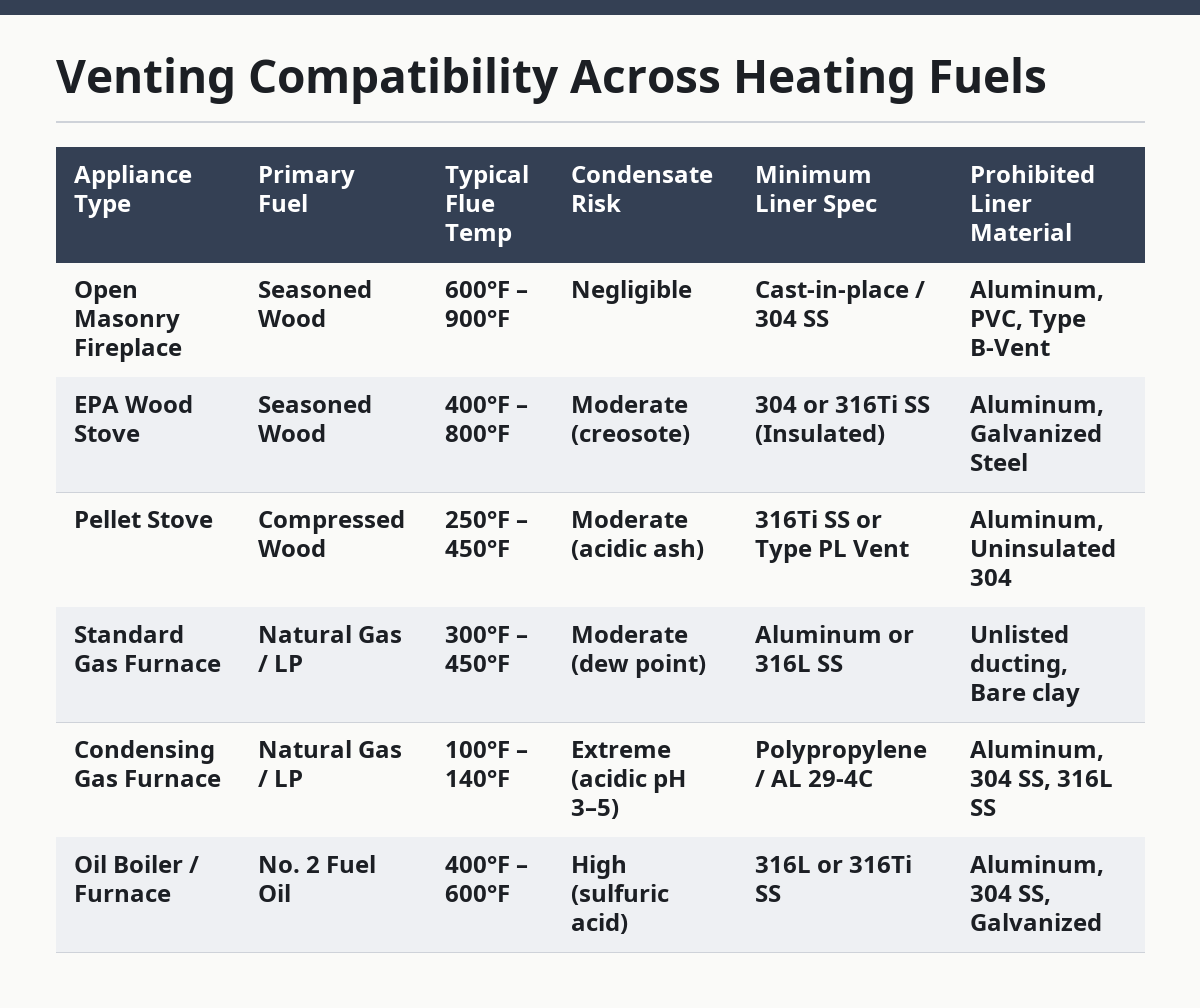
Venting Compatibility Across Heating Fuels
The table below contrasts the physical and chemical demands placed on chimney liners across common heating appliances:
| Appliance Type | Primary Fuel | Typical Flue Temp | Condensate Risk | Minimum Liner Spec | Prohibited Liner Material |
|---|---|---|---|---|---|
| Open Masonry Fireplace | Seasoned Wood | 600°F – 900°F | Negligible | Cast-in-place / 304 SS | Aluminum, PVC, Type B-Vent |
| EPA Wood Stove | Seasoned Wood | 400°F – 800°F | Moderate (creosote) | 304 or 316Ti SS (Insulated) | Aluminum, Galvanized Steel |
| Pellet Stove | Compressed Wood | 250°F – 450°F | Moderate (acidic ash) | 316Ti SS or Type PL Vent | Aluminum, Uninsulated 304 |
| Standard Gas Furnace | Natural Gas / LP | 300°F – 450°F | Moderate (dew point) | Aluminum or 316L SS | Unlisted ducting, Bare clay |
| Condensing Gas Furnace | Natural Gas / LP | 100°F – 140°F | Extreme (acidic pH 3–5) | Polypropylene / AL 29-4C | Aluminum, 304 SS, 316L SS |
| Oil Boiler / Furnace | No. 2 Fuel Oil | 400°F – 600°F | High (sulfuric acid) | 316L or 316Ti SS | Aluminum, 304 SS, Galvanized |
How Does Chimney Liner Selection Impact Appliance Efficiency and Draft?
Selecting the correct liner diameter and material directly controls the draft velocity needed to exhaust spent fuel and supply oxygen to the burner. Draft is generated by the temperature differential between the buoyant, hot column of air inside the chimney and the denser ambient air outside. This is known as the stack effect.
When a high-efficiency appliance vents into an oversized masonry flue—such as venting an oil furnace with a 5-inch collar into an unlined 8×12-inch brick chimney—the flue gases expand, slow down, and cool rapidly. This drop in temperature collapses the draft pressure. As a result:
- Combustion gases fail to exit the terminal cap, backing up into living areas as carbon monoxide.
- Flue gas temperatures fall below the 130°F dew point, triggering condensation that damages masonry and structural framing.
- The heating unit struggles against erratic backpressure, sooting up burners and increasing fuel usage by 5% to 15%.
Installing a dedicated, smooth-wall or properly sized corrugated liner restores the mechanical velocity of the exhaust path. Smooth interior walls reduce fluid friction by roughly 15% to 20% compared to corrugated profiles, providing cleaner draft for marginal setups with minimal vertical rise.
Related guidance on chimney draft basics and gas furnace venting can help you match liner size to appliance performance before installation.
Which Chimney Liner Mistakes Cause Premature Failure?
The most common installation failures stem from improper metal matchups, lack of insulation, and failure to support thermal expansion.
Downsizing or Over-sizing the Internal Diameter
Contractors sometimes downsize a liner from a 6-inch appliance outlet to a 5-inch pipe to squeeze through an unremoved damper opening or a pinched masonry flue. This can violate the appliance listing and NFPA 211 requirements, so follow the manufacturer instructions and consult a qualified installer. Restricted liners create flow resistance, resulting in smoke spillage into the living room whenever the stove door opens. Conversely, an oversized liner slows exhaust velocity, chilling the gas stream and accelerating creosote deposits.
Skipping Liner Insulation on Exterior Walls
Chimneys built along outside walls lose heat through external bricks. Installing an uninsulated stainless steel liner inside an exterior chimney results in creosote buildup when venting wood, or heavy condensation pooling when venting gas. When allowed by the listing and code, a 1/2-inch foil-faced ceramic blanket can improve draft and protect adjacent structural woodwork from pyrolysis—the slow chemical decomposition of wood caused by long-term heat exposure.
Intermixing Corrosive Fuel Streams
Connecting an oil appliance and a gas water heater into the same chimney without properly evaluating liner resilience often leads to liner failure. If you use an aluminum liner for the gas unit while venting an oil system in the same passage, the sulfuric acid exhaust from the oil burner will disintegrate the aluminum pipe. Multiple appliances sharing a flue chase must either vent into dedicated, isolated liners or connect via an engineered, code-compliant common manifold constructed of heavy-gauge 316Ti stainless steel. For a shared system, review common venting requirements before purchasing materials.
What Clearances and Safety Certifications Must You Verify?
Before purchasing materials, verify that every component carries an authentic listing mark from an accredited testing laboratory such as Underwriters Laboratories (UL) or Intertek (Warnock Hersey). For factory-built chimney lining systems, the baseline consumer safety standard is UL 1777 (Standard for Chimney Liners). This test subjects the liner to rigorous thermal tests:
- Continuous Operation Test: 1,000°F operating conditions for residential appliances.
- Ten-Minute Safety Test: 1,400°F exposure simulating heavy firing.
- Thermal Shock Test: Three separate 10-minute cycles at 2,100°F simulating recurring chimney fires.
“`
+——————————————————–+
| UL 1777 LISTED |
| ZERO-CLEARANCE TO COMBUSTIBLE CHIMNEYS |
| |
| – Tested with 1/2″ Ceramic Fiber Blanket Insulation |
| – Continuous Max Temp: 1,000°F (538°C) |
| – Transient Fire Test: 2,100°F (1,149°C) |
+——————————————————–+
“`
Uncertified, thin-gauge sheet metal pipes sold as utility ducting do not meet these parameters. If an unlisted pipe ruptures or melts during a flue fire, the home’s insurance coverage can be voided due to non-code-compliant materials.
Examine the label wrapped directly around the liner packaging. Look for the specific manufacturer, the verified UL file number, the allowed clearances to combustible materials (such as zero-inch clearance when insulated), and the approved fuel designations. Matching these physical markings to your appliance data plate ensures code compliance, long equipment lifespan, and structural fire safety. For more detail, see UL 1777 liner requirements and chimney clearance rules.
Drafted with AI; not yet reviewed by a person.

Related Posts

Chimney Liner Codes and Safety Requirements
How to Choose a Chimney Liner Installer
One thought on “How to Choose a Chimney Liner for Your Appliance”